


Back to Projects

Case Study · Community Heritage

The Kidmore End Well House Restoration

Saving a unique 1860s Victorian public well house — 280 feet deep, community-funded, and restored with scribe-rule timber conservation and the principle of maximum retention, minimum intervention.

Kidmore End, Oxfordshire May–September £24,000 community-funded restoration

The Project

A sad story with a happy ending

Partially restored in the 1980s, this lovely example of a Victorian public well house in the south Chilterns stood — just about — as a reminder of a bygone era. Socially and historically it is a vital heritage asset to the village and wider community. However, several years of repeated vehicle damage had left it dangerously close to collapse, with rotted sill plates, damaged braces, and a decaying shingle roof.

After a two-and-a-half-year process of advising, surveying, gaining permissions, and considerable planning, Chiltern Woodcraft finally started conservation repairs — backed by an MSc in Timber Building Conservation from the University of York, and the endorsement of the local community.

"Thank you so much for taking on this project which I am confident you will successfully complete. It's our most important heritage asset in the village!"

— Endorsement from the local community

Project Specifications

Date built
1860s
Well depth
280 ft (85 m)
Project cost
£24,000
Duration
3 months
Conservator
Andrew Jarvis
Carpentry
Jason Littlefield
Regional Press CoverageOctober 2026

Refurbished well reopens with flowers and songs

Kidmore End, Oxfordshire · Reported across Henley Standard & Windsor & Eton Express

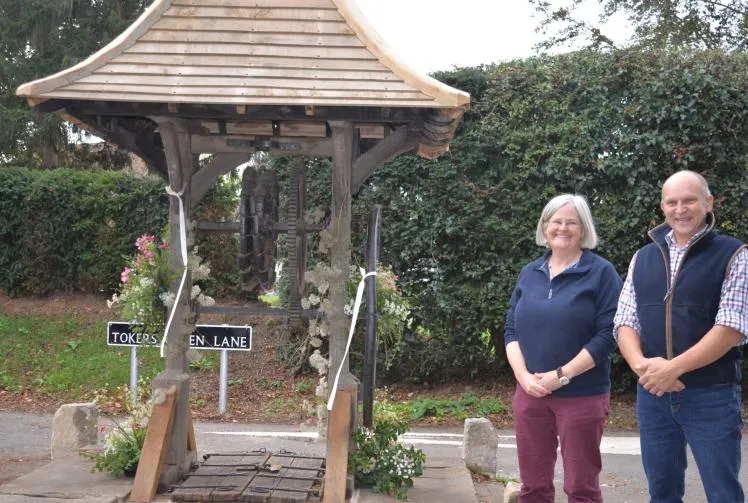
MORE than 50 villagers congregated around the well in Kidmore End on Saturday to mark the end of its refurbishment project. The well, off Tokers Green Lane, dates back to the 1860s, is 280ft deep and underwent three months of renovations at a cost of about £24,000.

Andrew Jarvis, a traditional craftsman from Woodcote, brought the need for repairs to the parish council's attention in 2023 after surveying the well, and was hired as the main contractor to restore it alongside colleague Jason Littlefield, from Oxford. The main problem was one corner which had rotted off, leaving the well head collapsing and held on by fibres — strands of wood no bigger than a finger. The whole structure was jacked up with metal screws, retaining the original handmade square nails throughout. The workmen used scribe rule, a traditional English way of fitting wonky timbers together, and uncovered apotropaic marks (witch marks) on one of the rafters, carved to keep bad spirits away from the public water supply. Four reclaimed stones were drilled into the square around the well to protect it from traffic. Andrew said: 'The theory is maximum retention, minimum intervention, which means you leave as much of the original as is possible. From a wellhouse perspective, other than the one down the road in Stoke Row, it's unique. I've studied all the Berkshire public wellhouses and this one really is different.'

Kidmore End Village Well Restoration as featured in the Henley Standard

"The theory is maximum retention, minimum intervention, which means you leave as much of the original as is possible. From a wellhouse perspective, other than the one down the road in Stoke Row, it's unique. I've studied all the Berkshire public wellhouses and this one really is different."

— Andrew Jarvis, Chiltern Woodcraft

Process & Execution

The restoration, phase by phase

From condition survey to grand opening — a chronological record of the careful conservation work that saved this cherished village landmark from collapse into the 280-foot well below.

01Timber ConservationMay 2025

Victorian Public Well House Condition Survey & Phase 1 Protection

A sad story to tell with a happy ending. Partially restored in the 1980's, this lovely example of a Victorian public Well house in the south Chilterns now stands (just about) as a reminder of a bygone era. Socially and historically it's a vital heritage asset to the village and wider community, however several years of repeated vehicle damaged have now left it dangerously close to collapse demonstrating rotted sill plates, damaged braces and decaying shingle roof.

Today however, Chiltern Woodcraft were really delighted to have the opportunity to expand on their MSc. in Timber Building Conservation (University of York) and put in place phase one of a restoration process by erecting this protective fencing around the Well house. The next phase is a full condition survey. Endorsed by the local community: 'Thank you so much for taking on this project which I am confident you will successfully complete. It's our most important heritage asset in the village!'

South Chilterns, Oxfordshire (Tokers Green Lane)
02Site Work & JackingJuly

Starting Conservation Repairs & Jacking Process on Well House

After a 2 1/2 year process of advising, surveying, gaining permissions and with considerable planning on our part, I'm delighted to say Chiltern Woodcraft finally started conservation repairs to this beautiful Well House structure on top of the chilterns, South Oxfordshire.

It's been wrapped up for several months now keeping it safe so today we uncovered the structure much to the delight of the villagers and after marking datum points we started the jacking process to allow new sills and braces to be installed using air dried oak. Note the decay! Once the structure is stable we can address the roofing and cross.

South Oxfordshire Chilterns

03Safety & Winding Gear17 July

Phase One: Working Over the 264ft Well Head in Safety Harness

Secured in a full-body safety harness directly over the 264-foot well opening, fitting the new oak sill plate frame and inspecting the historic cast-iron winding gear wheel and mortised frame joints.

Working directly over the sheer 264-foot drop of the Victorian public well required rigorous safety measures, including anchored full-body harness equipment. With the original cast-iron winding wheel and gear mechanism supported overhead, new air-dried oak sill plates and braces were mortised, tenoned, and pegged into place, ensuring maximum retention of historic fabric while securing the structure for another century.

Tokers Green Lane, South Oxfordshire

04Decayed Sills & Layout17 July

Phase One: Original Decayed Sill Plate Frame Layout & Replacement Sills

And just like that phase one is nearing completion. New sill plate frame and braces installed all pegged together, laid out alongside the original decayed Victorian sills. The frame now just needs levelling and mounting on a new lime mortar bed then the roof work begins.

A striking direct comparison on site: the severely rotted original Victorian sill plates laid out in the foreground, showing extensive fungal decay and timber fibre loss that had brought the well head dangerously close to collapsing 264 feet below. In the background, the new air-dried oak sill plate frame and braces have been converted, fitted, and pegged together, ready to be mounted on a fresh breathable lime mortar bed.

Tokers Green Lane, South Oxfordshire

05Timber Framing17 July

Phase One Sill Plate Frame & Braces Pegged — Saved From 264ft Drop

And just like that phase one is nearing completion. New sill plate frame and braces installed all pegged together. The frame now just needs levelling and mounting on a new lime mortar bed then the roof work begins.

It's been a joy to save this late Victorian structure from collapsing into the well 264 feet below. 'Maximum retention minimum intervention'! Thanks to J Littlefield's carpentry, what a star carpenter. Hand-cut traditional mortise, tenon, and pegged joints ensure the heavy air-dried oak will stand for decades to come.

Tokers Green Lane, South Oxfordshire

06Conservation & Discovery5 August

Well House Lowered on New Lime Mortar Beds & Apotropaic Marks Discovered

A busy time on the Well House, cill and brace repairs complete along with new lime mortar beds and some resisted where vehicles had repaired damaged them. The well house is now lowered back down onto its own feet again however, further roof investigation identified it to be in worse condition than originally thought...

...so repairs to rafter feet (missing in some cases) now being carried out and new oak boards ordered ready to be fitted with the original square headed nails. The new Cross is also ready for re-mounting on the top. Finally, have a look at 'could they be' photos.... They maybe just be Apotropaic marks carved to ward off evil spirits from the public water supply.

Kidmore End, South Oxfordshire

07Restoration Complete11 September

Kidmore End Well House Conservation Project Complete

Kidmore End Well House conservation project complete. Entire structure including winding gear jacked up, new cill plate frame and braces converted and fitted. Repairs made to rafter feet and new roof shingles fitted (nice to retain the original hand made nails).

New cross made and fitted and original well head doors reinstated. Stone work lifted and reset following repeated vehicle damage with reclaimed stone now installed to act as Saracen stones protecting the frame. Structure now lowered back into its rightful position. A nice place to be on a Friday afternoon. Huge thanks to J Littlefield carpentry for his excellent skills.

Kidmore End (Wood Lane / Tokers Green Lane)

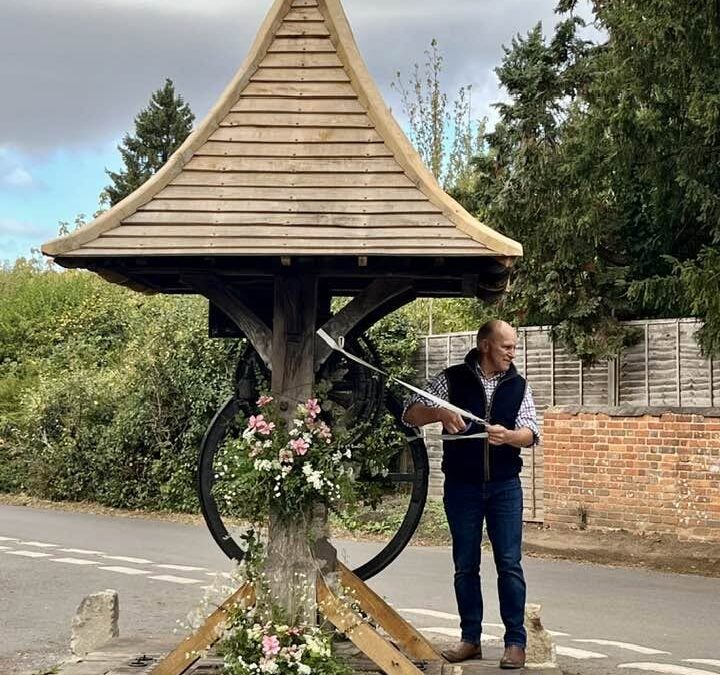
Andrew Jarvis cutting the ribbon at the Grand Opening of the renovated Kidmore End Well Head

Andrew Jarvis cutting the ribbon at 3pm, beside the restored well head decorated by Camilla Skinner with pink flowers in memory of Moira Lawrie.

Village Celebration · 10 OctoberKidmore End Parish Council

Grand Opening of Kidmore End Well House — Ribbon Cutting Celebration

Saturday 10 October · The renovated 1860s well head reopens to the village

On Saturday 10 October, the village was on tenterhooks waiting to see if the weather would hold fair for the ribbon cutting. Everything was in place. Camilla Skinner had decorated the well on the preceding Friday, with a stunning floral arrangement containing pink flowers to remember Moira Lawrie, the driving force behind the 'Flower Ladies'.

St John's Church was full of cake, limited edition well mugs, and hot tea, while members of the church choir rehearsed. Andrew Jarvis, the main traditional craftsman in charge of the Well Head renovations, stood ready to cut the ribbon.

And then people started to arrive to celebrate — all in all about 70 people came. What a turnout. The ribbon was cut at 3 pm, and Andrew explained what he had done to ensure that our well will be a stunning centrepiece in Kidmore End village for many years to come.

The village then retired to the church to warm up. What a magical party — the choir was exquisite, the cakes marvellous, the tea hot, and the church was full of good humour, good conversation, and lovely music.

Conservation ethos

Maximum retention, minimum intervention

Scribe-rule joinery

A traditional English method of fitting wonky, irregular historic timbers together — hand-cut mortise, tenon, and pegged joints in air-dried oak.

Apotropaic marks

Witch marks discovered carved into one of the rafters — originally placed to ward off evil spirits from the public water supply.

Saracen stones

Four reclaimed stones drilled into the square around the well to protect the restored structure from future vehicle damage.

Chat on WhatsApp